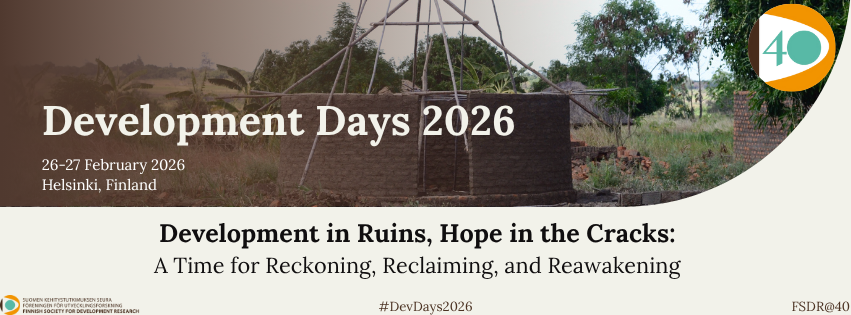
Development Days Conference 2026
Development in Ruins, Hope in the Cracks: A Time for Reckoning, Reclaiming, and Reawakening26-27 February 2026 | Päärakennus (Main Building), University of Helsinki
Conference update
Development Days Conference 2026 took place on 26–27 February 2026 at the University of Helsinki (Main Building) and online. Thank you to all participants, working group coordinators, speakers, volunteers, and partners who made #DevDays2026 possible.
We extend our warm thanks to our keynote speakers, Walden Bello and Robtel Neajai Pailey, and to Ullamaija Kivikuru and Kaarle Nordenstreng for marking FSDR’s 40th anniversary with their reflections on the society’s history.
The conference programme remains available here, as well as the pre-conference events. Accepted presentations are listed on each Working Group page.
For any post-conference queries (e.g., certificates of participation, invoices/receipts), please email: info.developmentdays@gmail.com
Post-conference resources
- Book of Abstracts
- Recordings (Opening ceremony, Keynote lectures and plenaries): DevDays2026 Youtube Playlist
Development Days 2026 Conference Concept Note
We live in a ruined and ruining world. The postwar program and edifice of “development” as we know it—built on the assumptions of linear progress, donor-driven aid, and international cooperation—is crumbling. Development’s failures, rooted in the colonial and capitalist world-system, are manifest: in the stark precarity and inequalities sharpening under economic neoliberalism; in the climate emergency spiraling beyond control; in the defunding of social institutions and public services amid rising securitization and militarization; in the surge of reactionary, ethno-nationalist, and authoritarian-populist politics eroding human dignity and global solidarities; and in the realities of genocide, forced displacement, and mass starvation — cruelties inflicted against humanity.
These ruins in the contemporary polycrisis, entangled with the history of extractive capitalism and colonialism, demand profound reckoning. Yet, in the cracks—within the fissures and margins of the prevailing disorder—seeds of hope are already germinating. This hope is found both in the recognition of diverse forms of human coexistence that predate Western hegemony, and in vibrant new movements. From struggles for climate action, equality, peace, and food sovereignty, to feminist economies of care and Indigenous knowledge reclamations, to the uprisings led by students and the youth, people are reawakening consciousness and reclaiming agency, spaces, and the commons. These are not simply strategies of survival, but practices of community-building and world-making that prefigure life beyond the colonial capitalist paradigm of development.
Coinciding with the 40th anniversary of the Finnish Society for Development Research, the #DevDays2026 international conference calls on scholars, practitioners, and activists to share their studies, reflections, advocacies, and experiences in engaging this dialectic of ruin and hope. We ask: How do we reckon with the ruins of development? How do we learn from, and nurture, the cracks where hope takes root? And how do we reawaken political consciousness for socio-ecological and economic-cultural transformation?
This gathering is more than critique. It is an invitation to self-reflection on Reckoning, Reclaiming, Reawakening toward renewal. As we reflect on four decades of critical development research in Finland, we take up the challenge not only to analyze collapse but to actively participate in the collective labor of reimagining and advancing futures of justice, care, and solidarity.
Keynotes and Plenary Roundtable
The Keynote Lecture will be delivered by Walden Bello (Honorary Senior Research Fellow, State University of New York & Co-Founder, Focus on the Global South) on “Revisiting Deglobalization in an Era of Geopolitical Competition”. The Keynote Conversation on “Alternative Development in a Post-Aid World” will be led by Robtel Neajai Pailey (Assistant Professor, London School of Economics and Political Science). The Plenary Roundtable on “The State of Development Research: Critical Perspectives from Finland, Europe, and the Global South” will have a panel comprising Anja Nygren, Eleanor Fisher, Alfredo Saad-Filho, and David Barkin.
Working Groups
This year’s conference is organized around 20 selected Working Groups. We invite you to explore them and see the accepted presentations listed on each Working Group page.
Important dates
● 12.01.2026: Registration opens
● 15.02.2026: Registration closes
● 25.02.2026: Pre-conference events (DocShop, Master’s Workshop, Public Forum)
● 26.-27.02.2026: #DevDays2026 Conference in Helsinki
In line with our commitment to democratizing, diversifying, and decolonizing development knowledge, we welcome online participation and hybrid engagement. We particularly encourage collaboration with colleagues from the Global South.
For more information and updates, please visit the conference website regularly, follow FSDR’s social media pages (Facebook and LinkedIn), or write to us at info.developmentdays@gmail.com.
Organizers
The Finnish Society for Development Research (FSDR), in collaboration with the University of Helsinki, Finnish University Partnership for International Development (UniPID), the Helsinki Institute of Sustainability Science (HELSUS), Federation of Finnish Learned Societies, the City of Helsinki, and Global Visions