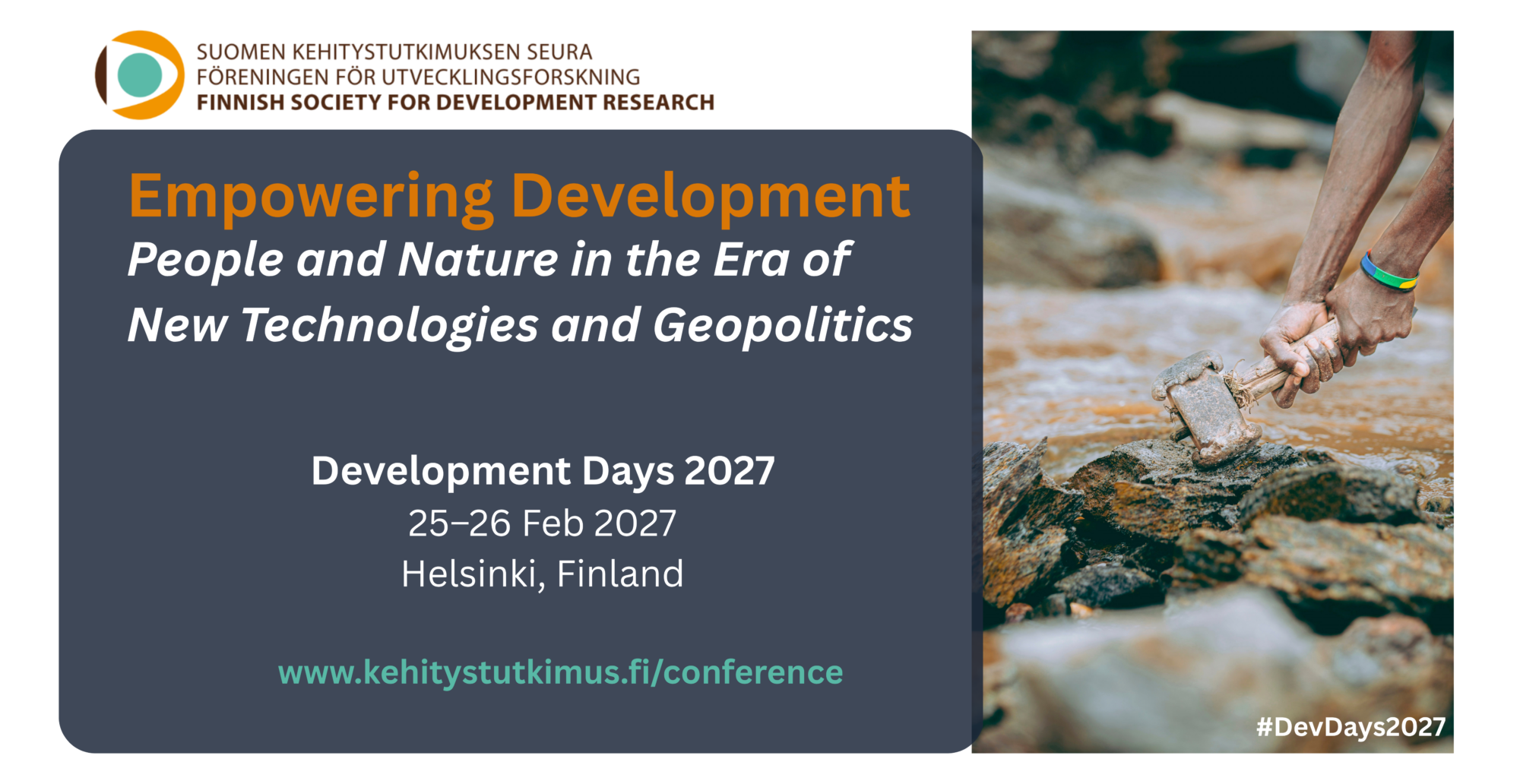
DevDays2027 Call for Working Groups is Now Open!
Deadline for Proposals: 15 October 2026
Submit to: info.developmentdays.gmail.com
DevDays2027 invites scholars, practitioners, activists, and educators to share research, reflections, and advocacy addressing key questions: How do new technologies reconfigure power, precarity, movements, and resistance in the lives of people and nature? Amid shifting geopolitical fault lines, how do we cultivate relations of care, democratic governance, and alternative futures that empower human and ecological thriving? And how do we defend and advance the ethos and institutions of development against political hostility and governmental retrenchment?
At this juncture in world history, new dynamics in geopolitics and rapid progress in disruptive technology pose existential challenges to people and nature, and by extension to development studies as a discipline. Climate breakdown, war and the renewed spectre of nuclear annihilation, and a hypercompetitive race for energy, minerals, land, and resources under the banner of innovation, now compounded by public debate over artificial intelligence’s own capacity to inflict catastrophic risks on critical social infrastructures, including by lowering the barriers to engineering biological weapons, make this urgency material rather than rhetorical.
These dangers may not be unprecedented but can be regarded as capitalism and colonialism reasserting themselves through new technological and geopolitical forms. This moment calls on us to examine the contemporary forces bearing on the day-to-day and future existence of human beings and the natural environment. Dominant political, economic, and cultural trends and practices have disempowered development ideas, institutions, and constituencies. Yet amid the strong negative tendencies wrought by emerging technologies and intensifying geopolitics, this is also the time to reflect on, and act toward, empowering what lies at the heart of development research: people and nature.
Among other objectives of this gathering, our task is to assert our field’s vitality and cooperate with the development community in finding opportunities for collaborative endeavors. In an increasingly volatile world, our responsibility is not only to diagnose contemporary problems but to actively participate in building futures for human dignity, ecological integrity, and global solidarity.
Sub-themes for Working Groups
We invite proposals for Working Groups in a range of formats – academic panels, policy discussions, activist forums, poster sessions, or creative interventions. Submissions are encouraged to engage with the conference theme, including but not limited to the following areas:
- People, Nature, and Technological Change
- The impacts of AI, Big Tech, platform capitalism, algorithmic management, and digitalization on humanity and ecology, especially on workers, societies, economies, and communities in emerging markets and developing countries
- Geopolitical ecologies of cloud computing, data centers, e-waste, and water and energy injustice
- Digital colonialism and data extractivism: the Global South as an extraction zone of rare earth minerals and human labor
- The crisis of social reproduction: labor precarity, global care chains, and the erosion of human welfare
- The green-digital transition and the creation of new resource frontiers
- Technological sovereignty, digital commoning, and innovations for social liberation
- Land commoning, forests, biodiversity, and socio-ecological transformation
- Rights of nature and environmental defenders
- Advancing the Field of Development: Politics, Policy, and Global Solidarity
- Politicization and securitization of academic research and development policy
- The politics of de-funding: austerity, ODA withdrawal, and ideological hostility toward development cooperation
- The weaponization of aid: arms trade, militarization, and border regimes
- Peace, demilitarization, and anti-war movements
- Financialization of aid, private-sector development, and the prospects for a post-aid world
- Crises of legitimacy in global governance and multilateral institutions
- Defending academic freedom and development studies as an enduring and emancipatory space
- Forming resilient networks of knowledge production, civil society, and South–South–North academic solidarities
- Geopolitics, Power, and Cultivating Alternatives
- Geopolitical fragmentation, multipolarity, imperial rivalry, and resource nationalism
- The US–China AI race and its implications for Middle Powers and the Global South
- Feminist economies of care and eco-social reproduction
- Just sustainability, multispecies or multibeing justice, and planetary well-being
- De-commodifying public goods and creating community-led resilience against marketization
- Pluriverse, decolonial, post-development, and degrowth agendas
- Indigenous, peasant, worker, youth, and gendered and racialized struggles for land, water, food, and the commons
- Methodologies, popular and formal education, and action research for empowering people, nature, and transformative futures
Submission Guidelines and Timeline
Please submit a 300-word proposal, including the contact details of the Working Group Coordinator(s), by 15 October 2026 to info.developmentdays@gmail.com.
● 15.09.2026: Call for working groups opens
● 15.10.2026: Deadline for working group proposals
● 21.10.2026: Acceptance of working groups
● 28.10.2026: Call for papers opens
● 25.11.2026: Deadline for paper abstract submission
● 04.12.2026: Notification of accepted abstracts
● 11.01.2027: Registration opens
● 15.02.2027: Registration closes
● 24.02.2027: Pre-conference events (DocShop, Master’s Workshop, Public Forum)
● 25.-26.02.2027: #DevDays2027 Conference in Helsinki
In line with our commitment to democratizing, diversifying, and decolonizing development knowledge, we welcome online participation and hybrid engagement. We particularly encourage collaboration with colleagues from the Global South.