
This is a republication of the “Meet a Wisdomer” section of JYU.Wisdom Newsletter 1/26, by the School of Resource Wisdom, University of Jyväskylä, featuring FSDR Chair Bonn Juego.
Meet a Wisdomer: Bonn Juego
“Redefining Sustainability through Justice, Peace, and Planetary Well-being”
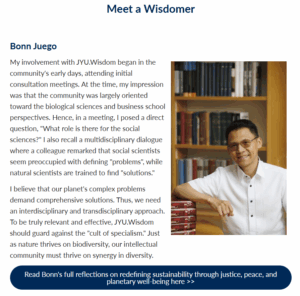
Q: How did you become a part of the JYU.Wisdom community?
Bonn: My involvement began in JYU.Wisdom’s early days, attending initial consultation meetings. At the time, my impression was that the community was largely oriented toward the biological sciences and business school perspectives. Hence, in a meeting, I posed a direct question, “What role is there for the social sciences?” I also recall a multidisciplinary dialogue where a colleague remarked that social scientists seem preoccupied with defining “problems,” while natural scientists are trained to find “solutions.”
I believe that our planet’s complex problems demand comprehensive solutions. Thus, we need an interdisciplinary and transdisciplinary approach. To be truly relevant and effective, JYU.Wisdom should guard against the “cult of specialism.” Just as nature thrives on biodiversity, our intellectual community must thrive on synergy in diversity.
Q: You’ve recently proposed the concept of “just sustainability” for the upcoming Wisdom Days 2026. How does this differ from mainstream sustainability?
Bonn: Mainstream sustainability is often trapped within the very ideologies that created our ecological crises: capitalism, colonialism, nationalism, and individualism. It tends to focus on growth obsession, techno-fixes, market-oriented policies, and an individualistic ethos that allow business-as-usual to continue.
In contrast, “just sustainability” is both an analytical framework and a call to action. It problematizes how our current mode of production profits from the accumulation of waste— not merely material waste, but primarily through “wasted living” and “wasted lives.” The conventional understanding of capitalism is that capitalists earn money by expropriating surplus through the exploitation of workers’ productivity; in reality, however, capitalism extracts tremendous profits by wasting nature and human lives, converting “valuable beings” into “wasteful things.”
In advancing an agenda toward planetary well-being, we must treat insularity as a problem alongside Eurocentrism and Americentrism. We need a global and historical perspective founded on the principle of justice. Among other strategies, this entails diversifying our economies, decolonizing our minds and institutions, and deglobalizing exploitative supply chains.
Bonn: Planetary well-being captures the necessary synthesis and synergy of socio-ecological life. My work provides a critical, political-economic grounding for it. We cannot achieve planetary well-being while our global economy—and the politico-cultural institutions embedded in it—is organized around capital accumulation that requires economic inequality, ecological degradation, and social exploitation.
The well-being of a forest, a river, a community, and the climate are interconnected. A just sustainability framework asks: who has the power to define “well-being,” and how are resources produced, valued, and allocated? It insists that well-being must be defined democratically and pluriversally, not by the self-serving agendas of abusive states and corporations invested in the status quo.
Bonn: We are living in a moment of extreme danger. The rise and popularity of narcissistic megalomaniacs with fascist tendencies—most notably Donald Trump, Big Tech oligarchs, and their like-minded allies—is accelerating the doomsday clock. The “America First” policy is not a retreat from neoliberal globalization; it is a violent response to hyper-competition in contemporary global capitalism, which even the USA can no longer control.
Imperialist wars are the architecture that entrenches the military-industrial-financial-oil complex and the racial-gender-class supremacy of the white male capitalist class. These wars of conquest and aggression are an existential threat to humanity and nature. At the same time, we cannot allow ourselves to be distracted by the inter-elite squabbles between hypocritical liberal internationalists and fascist nationalists. Both are forms of elite capture that facilitate a structural genocide against the planet’s future.
Bonn: We cannot separate ecological destruction from the machinery of war. Imperialism is often a project and process of imposing power and securing resources at the cost of human lives and local ecosystems. In a public forum, I was quoted emphasizing: “Divest from wars and invest in life.” War is the ultimate “waster” of nature and humanity.
—
Bonn Juego is a political economist and Senior Lecturer in International Development Studies at the University of Jyväskylä, where he is a core teaching staff for DEICO—the Master’s Programme in Development, Education and International Cooperation. He is currently serving his third term as the Chair of the Finnish Society for Development Research. A former University Lecturer in World Politics at the University of Helsinki, he has also taught sustainability strategies and corporate environmental management at the Jyväskylä University School of Business and Economics. He is an invited contributor to the Great Transition Initiative and a member of the founding editorial board of Just Ecological Political Economy: The HELSUS Global South Blog.
Source: JYU.Wisdom Newsletter 1/26